An Embattled Bird
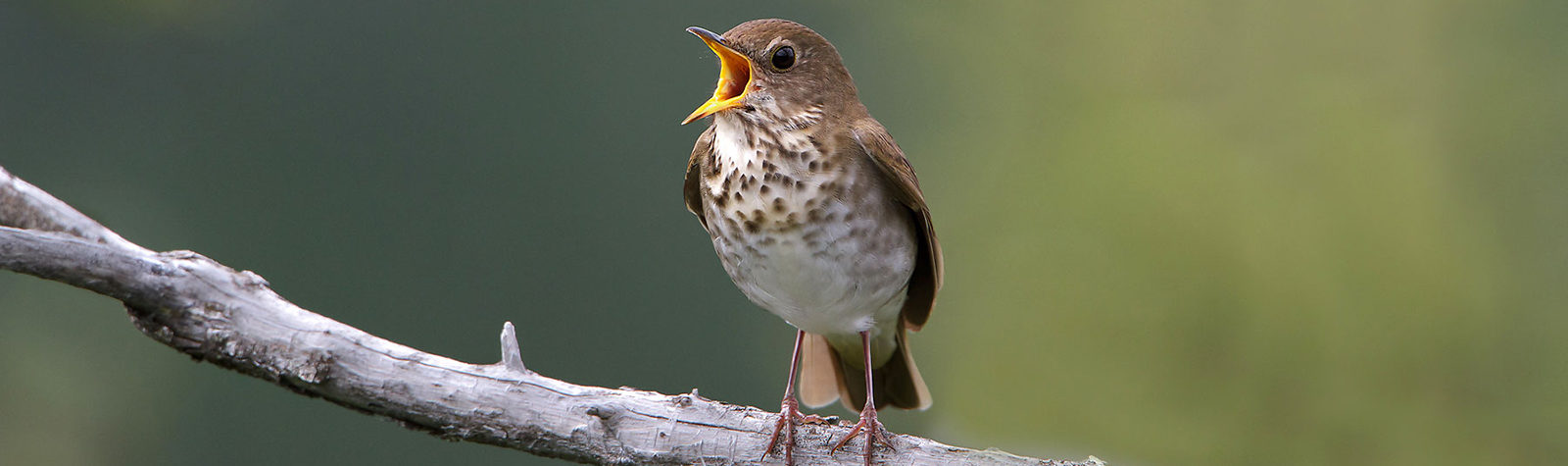
Bicknell’s Thrush is among the landbird species of highest conservation concern in North America. A rare and geographically restricted habitat specialist of balsam fir-dominated forests in the northeastern U.S. and southeastern Canada, Bicknell’s Thrush is estimated to number fewer than ~125,000 individuals.
The species is at risk from a variety of threats to its breeding habitats, including recreational development, telecommunication construction, wind power development, acidic precipitation, mercury deposition, and climatic warming.
On its Caribbean wintering grounds, where an estimated 90% of the global population is concentrated on Hispaniola, loss of forested habitats has been severe and is ongoing. Recent monitoring of breeding populations indicates consistent, rangewide declines, especially in Canada.
Building a Coalition
In response to heightened conservation concerns for Bicknell’s Thrush, a coalition of scientists, natural resource managers, and conservation planners formed during the fall of 2007. The International Bicknell’s Thrush Conservation Group (IBTCG) held its inaugural meeting in Woodstock, Vermont, with 25 people attending from five northeastern states and two Canadian provinces.
The group’s overall charge is to develop and implement a Conservation Action Plan for Bicknell’s Thrush, which was finalized and released in July 2010. Participants in the IBTCG include representatives from academia, federal and state conservation agencies, non-governmental organizations, and industry.
Conservation Goals
- Increase the global population of Bicknell’s Thrush by 25% over the next 50 years (2011-2060).
- Ensure no further net loss of distribution of Bicknell’s Thrush across its breeding and winter ranges.
- Implement and sustain a rangewide breeding season monitoring program.
- Implement direct conservation and research actions that will address identified threats to Bicknell’s Thrush, leading to improved protection, management and restoration of breeding and wintering habitats.
Coordination Committee
IBTCG is a flexible, inclusive group of more than 40 people from over 25 organizations with a shared commitment to Bicknell’s Thrush conservation. The group is organized by a coordination committee comprised of numerous partners who will seek funding, maintain momentum, set meetings and agendas, and identify next steps.
2023-present
- Jim Goetz (Chair), Vermont Center for Ecostudies
- Peter Thomas, Canadian Wildlife Service
- Yves Aubry, Canadian Wildlife Service
- Amy-Lee Kouwenberg, Birds Canada
- Yolanda Leon, Grupo Jaragua
- Randy Dettmers, U.S. Fish and Wildlife Service
2019 – 2022
- Chris Rimmer (co-Chair), Vermont Center for Ecostudies
- Peter Thomas (co-Chair), Canadian Wildlife Service
- Yves Aubry, Canadian Wildlife Service
- Greg Butcher, U.S. Forest Service International Program
- Amy-Lee Kouwenberg, Bird Studies Canada
- Yolanda Leon, Grupo Jaragua
- Randy Dettmers, U.S. Fish and Wildlife Service
2015 – 2019
- John Lloyd (Chair), Vermont Center for Ecostudies
- Yves Aubry, Canadian Wildlife Service
- Greg Campbell, Bird Studies Canada
- Randy Dettmers, U.S. Fish and Wildlife Service
- Eduardo E. Iñigo-Elias, Cornell Lab of Ornithology
2007-2015
- Chris Rimmer (Chair), Vermont Center for Ecostudies
- Becky Whittam (Chair), Canadian Wildlife Service
- Randy Dettmers, U.S. Fish and Wildlife Service
- Yves Aubry, Canadian Wildlife Service
- Kent McFarland, Vermont Center for Ecostudies
Partners