![]() |
Have you seen a Bicknell's Thrush? Consider adding it to eBird to help us track locations. Would you like to help monitor populations? In the U.S. join Mountain BirdWatch In the Maritimes join the High Elevation Landbird Program In Quebec join Regroupement QuébecOiseaux Breaking News
|
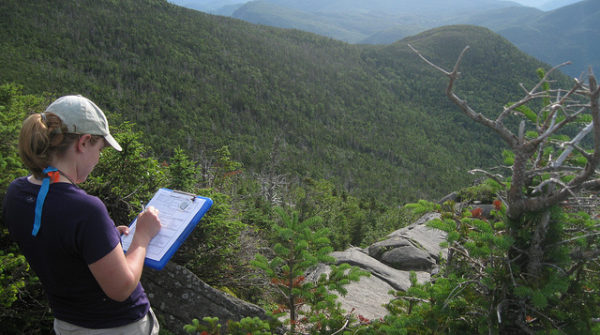
Two pioneering Bicknell’s Thrush studies paved the way for the recent surge of research and monitoring efforts completed or underway in the northeastern U.S., Canada, and the Caribbean Greater Antilles. George Wallace’s classic natural history study (Wallace 1939), conducted in the mid-1930s on Vermont’s Mt. Mansfield, illuminated basic facets of the (then sub) species’ taxonomy, habitat use and biology. It remains a solid reference today. Henri Ouellet’s careful examination of Bicknell’s and Gray-cheeked thrush in the early 1990s (Ouellet 1995) compared characteristics of plumage, morphology, vocalizations, distribution, and biochemistry. His proposal to the AOU Checklist Committee that Bicknell’s Thrush be classified as a distinct species from Gray-cheeked Thrush was accepted, immediately heightening both awareness and concern for the conservation status of this “new” and rare species. Research on Bicknell’s Thrush since Ouellet’s pivotal study has spanned efforts to investigate the species’ breeding and winter distribution and habitat preferences, its unique breeding ecology, its use of ski areas and industrial forests, its overwinter ecology and demography, and its ecotoxicology. Long-term monitoring of breeding populations has been established via Mountain Birdwatch (MBW) in the U.S. and Canada.
Maritimes (New Brunswick and Nova Scotia) 1995-2001 Canadian Wildlife Service (CWS; Dan Busby lead) surveyed the Maritimes to document locations where BITH was present and to obtain rough estimates of numbers and habitats. 1997-98 Erin Nixon was contracted to write the status report for the Committee on the Status of Endangered Wildlife in Canada. BITH was listed as “Special Concern”. 1998 Erin Nixon, working for Canadian Forestry Service, conducted point counts and transects on industrial forest land in NB. 1998 Two Honour’s theses were completed with Tony Diamond at the University of New Brunswick (UNB) by Geoff Clarke and Richard Curran (both spatial analyses of NB habitat). 1999-2001 Erin Nixon completed her Master’s degree with Tony Diamond at UNB on habitat associations in NB industrial forest. 2001 Bird Studies Canada conducted field work in Cape Breton to develop a protocol for monitoring BITH and other high elevation bird species. 2002 High Elevation Landbird Program (HELP) began. Protocol was modified in 2003 to mesh with VINS Mountain Birdwatch. 2004-05 Sarah Chisholm conducted her Master’s research with Marty Leonard of Dalhousie University on the impact of pre-commercial thinning on abundance of Bicknell’s Thrush and other high elevation birds. 2005 CWS, with Matt Mahoney, conducted some habitat modeling, based on latitude/elevation model by Lambert et al. 2006 Rob Gardiner completed Honour’s thesis with Matt Evans at Mount Allison University on the long-term effects of pre-commercial thinning on Bicknell’s Thrushes and four other high elevation songbirds in the New Brunswick highlands. 2006-2010 Fieldwork for the second Maritimes Breeding Bird Atlas underway. 2007 Kevin Fraser began PhD with Tony Diamond at UNB on how wintering habitat impacts breeding condition 2009 Emily McKinnon defended her Master's thesis with Tony Diamond at UNB on Bicknell's Thrush 2009 Seven-year analysis (2002-2009) of HELP data shows declines on the order of 17% per year in New 2009 The Committee on the Status of Endangered Wildlife in Canada recommended Threatened status for 2009-2010 As part of a rangewide study of migratory patterns and connectivity, solar geolocators were placed 1990s In Quebec, the first person to investigate the Bicknell’s Thrush was the late Henri Ouellet who worked with Gilles Seutin to have the Bicknell’s Thrush recognized as a distinct species from Gray-cheeked Thrush. 1993 Since the beginning of the Quebec sites monitoring for bird populations at risk, QuebecOiseaux has been 1999-2000 Veronique Connolly conducted her M.Sc. research with Gilles Seutin and Jean-Pierre L. Savard (CWS), focusing on habitat used during the breeding period. 1997-98 Surveys were conducted at specific sites in southern Quebec by Y. Aubry (CWS) and team. Sites visited were located in the Laurentians, in the Estrie region, and on the Gaspé Peninsula. At the same time, Charlevoix was surveyed and some birds banded. 1999 A banding and radio-telemetry project began at Mine Madeleine (Gaspésie National Park). Intensive work ended in August 2003. Researchers video-monitored activities at nests from 1999 to 2003 and recorded movements of radio-tagged birds. 1999 Melanie Ball conducted field work at Mine Madeleine for a Master’s thesis on Bicknell’s Thrush vocalizations under the supervision of Cindy Staicer, Dalhousie University. 2000 Yves Aubry started Ph.D. research at Laval University (André Desrochers, Director and Gilles Seutin, co-directors). Research topics are summarized here:
2000-2004 Point-count surveys (129 stations; 2000-2004), banding, radio-telemetry, as well as nest video-monitoring were conducted at Mount Gosford. 2005 Extensive surveys were conducted at 389 sites throughout the Gaspé Peninsula. Sites were selected according to altitude (>600 m or <600 if within 15 km of coast) and habitat suitability (Balsam Fir as dominant or co-dominant species of forest stands). BITH was detected at 18 of the 389 sites. 2006 BITH surveys were done in an area north of Baie-Comeau, on the North shore of the St. Lawrence River. The study area was located on the edge of the Laurentian Shield, just south of the Manicougan reservoir. Of the 400 point-counts done, Bicknell’s Thrush was recorded from only 2. There are a handful of previous records originating from the North Shore of the St. Lawrence River, where Black Spruce dominates the landscape with Balsam Fir restricted to small dispersed stands. 2007 At Massif du Sud (60 km east of Quebec City), surveys were conducted at 183 sites between May 31 and June 15; 41 were occupied by BITH. This site is targeted by a wind-power development project. The goal is to identify local Bicknell’s Thrush concentrations/distribution, habitat used and potential impacts of the windmill project on its habitat and the species itself. At Mont Gosford, the 131 point-counts done in 2000-2004 were repeated to determine whether Bicknell’s Thrush abundance and occurrence has changed. Results are pending. 2008 A survey of the Bicknell's Thrush population was completed by QuebecOiseaux in the area of Mont Saddle, in the south-eastern part of Quebec. These 3000 hectares of forested land belong to Domtar and were planned to be harvested in the winter of 2008. With the results of the survey and further discussions between QuebecOiseaux and Domtar's representatives, it was decided that half of the land would be left untouched while the other half would be selectively cut while maintaining dense second-growth regenerating fir stands. 2009-2010 As part of a rangewide study of migratory patterns and connectivity, solar geolocators were 1994-97 BITH distribution and habitat use study in Dominican Republic (DR)
1998-99 BITH surveys conducted in Blue and John Crow Mts of Jamaica.
1999 Yves Aubry initiated surveys in Cuba in 1999 with local collaborators Alejandro Llanes from the Instituto de Ecologia y Sistematica and Arturo Kirkconnell from the Museo Nacional de Historia Natural both in La Havana.
2001-07 BITH sexual habitat selection and overwinter ecology research (Jason Townsend PhD work)
2001-07 Collection of mercury samples on Hispaniola and Cuba
2004-07 BITH surveys conducted in two protected areas of Haiti (Macaya and La Visite)
2005 Hispaniola eBird implemented 2006 Birds of the Dominican Republic and Haiti published (Latta et al. 2006) 2008-2010 VCE coordinates field training workshops for Hispaniolan and Cuban conservation partners in 2009-2010 VCE joins Vermont partner AgRefresh and multiple Dominican partners to initiate a Payment for United States (Monitoring, Research) 1992-94 VINS (now VCE) and Manomet Center for Conservation Sciences conduct a distributional survey for BITH in U.S. Northeast (Atwood et al. 1995, Rimmer et al. 1995) 2000 Mountain Birdwatch (MBW) piloted in Vermont, building on a small network of high-elevation forest bird monitoring routes already active in Vermont and Maine 2001 MBW expanded to include 160 sites in five states, 120 of which are monitored annually. Preliminary BITH distribution model completed for U.S. 2002 Conservation status of BITH habitat assessed throughout U.S. range 2003 MBW first projects effects of climate change on future distribution of BITH. MBW and HELP align protocols. 2004 MBW measures 9% annual decline in BITH on 47 routes surveyed every year (2001-2004) 2005 A practical model of BITH distribution published in Wilson Bulletin 117:1-11. Numbers of BITH and other target species appear to rebound. 2006 MBW collaborates with US Forest Service on White Mountain National Forest (WMNF) 1993-2003 trend analysis for BITH and other species; BITH show significant 7% annual decline 2007 Mountain Bird Working Group of the Northeast Coordinated Bird Monitoring Partnership is formed. 2007 WMNF trend analysis published (King et al. 2007) 2007 Projected effects of climate change (Rodenhouse et al. 2008) 2007 Mountain Birdwatch joins Avian Knowledge Network 2008 Additional WMNF BITH population trend analyses published (Lambert et al. 2008)
1993-2007 Intensive demographic and ecological BITH studies on Mt. Mansfield (1993-2007), Stratton Mountain (1997-2007), and East Mountain (2004-2007) in Vermont. Highlights through 2007 include:
1995-97 Fall stopover ecology study on Mt. Mansfield, published in (Rimmer and McFarland 2000)
1997-2003 Studies of ski area impacts on BITH on Mt. Mansfield and Stratton Mountain, VT
1998-2001 Research on BITH mating system and breeding ecology
2000 Collection of BITH blood and feather samples for mercury begins (also Canada); ongoing
2001 Walter Ellison PhD dissertation on population structure and gene flow in BITH and VEER
2001 BITH Birds of North America account published (Rimmer et al 2001) 2001 “Bicknell’s Thrush Conservation Assessment” report to U.S. Forest Service 2001 Tail feather stable isotopes from U.S. and Canadian sites suggest mixing of breeding populations on Hispaniola (Hobson et al. 2001) 2004-07 Baseline data collection for study of wind power impacts to BITH on East Mountain, VT; Turbine construction denied in 2006; future of research undetermined. 2008 Report to Vermont Fish and Wildlife Department “Demography, ecology and conservation of Bicknell’s Thrush in Vermont, with a special focus on the Northeastern Highlands” (McFarland et al. 2008) 2009 Data on mercury in the montane forest food web (leaf litter, foliage, arthropods, salamanders, BITH, raptors) published (Rimmer et al. 2009) 2009-2010 As part of a rangewide study of migratory patterns and connectivity, solar geolocators were placed on 37 adult Bicknell’s Thrushes in the Catskill Mountains (5 on Plateau, 17 on Slide) and Green Mountains (15 on Mt. Mansfield). Three of these were recovered in 2010. New lighter geolocator,s attached with a more secure method, were deployed on Mt. Mansfield and the White Mountains, NH during 2010.
|
|
International Bicknell's Thrush Conservation Group 802-649-1431 (U.S.) 506-364-5047 (Canada) info AT vtecostudies.org © IBTCG 2008 |